

Creative Arts Gateway
Creative Arts Gateway
Creative Arts Gateway
Princeton University
“As catalysts for transformation, the visual and performing arts rely on sequences of action, revision, repetition, and opportunistic exchange to produce critical change. Architecture, as a synthetic art, requires a range of media and techniques to describe both the fixed and the ephemeral.
The superimposition of different modes of representation in the Line and Shadow seminars established a starting point for translation into architectural space. This project extends that question: how can hybrid and layered methods of representation generate new spatial sequences and new architectural programs?”
— Course description by Marion Weiss
This project began with a reverse process.
Rather than starting with site or program, the design grew out of the study of two small architectural fragments. Through drawing, repetition, and translation, these fragments were developed into a larger spatial system, then tested against site and program.
ITERATION 1
Formal Extraction
Images were taken behind 30th Street Station in Philadelphia. Structural and electrical elements along the rail corridor — I-beam frames, trusses, track alignments, suspension insulators, and transformer units — were studied as a system of lines, frames, and nodes.
These elements were then arrayed, repeated, and scaled through successive iterations. The process moved from hand drawings in pencil and ink to digital manipulation in Photoshop.
Drawing was used as a generative tool rather than a descriptive one. Linear systems, structural frames, and nodal interruptions were developed through repetition, alignment, and variation to produce new spatial relationships.

Click to Enlarge
ITERATION 2
Site Confrontation
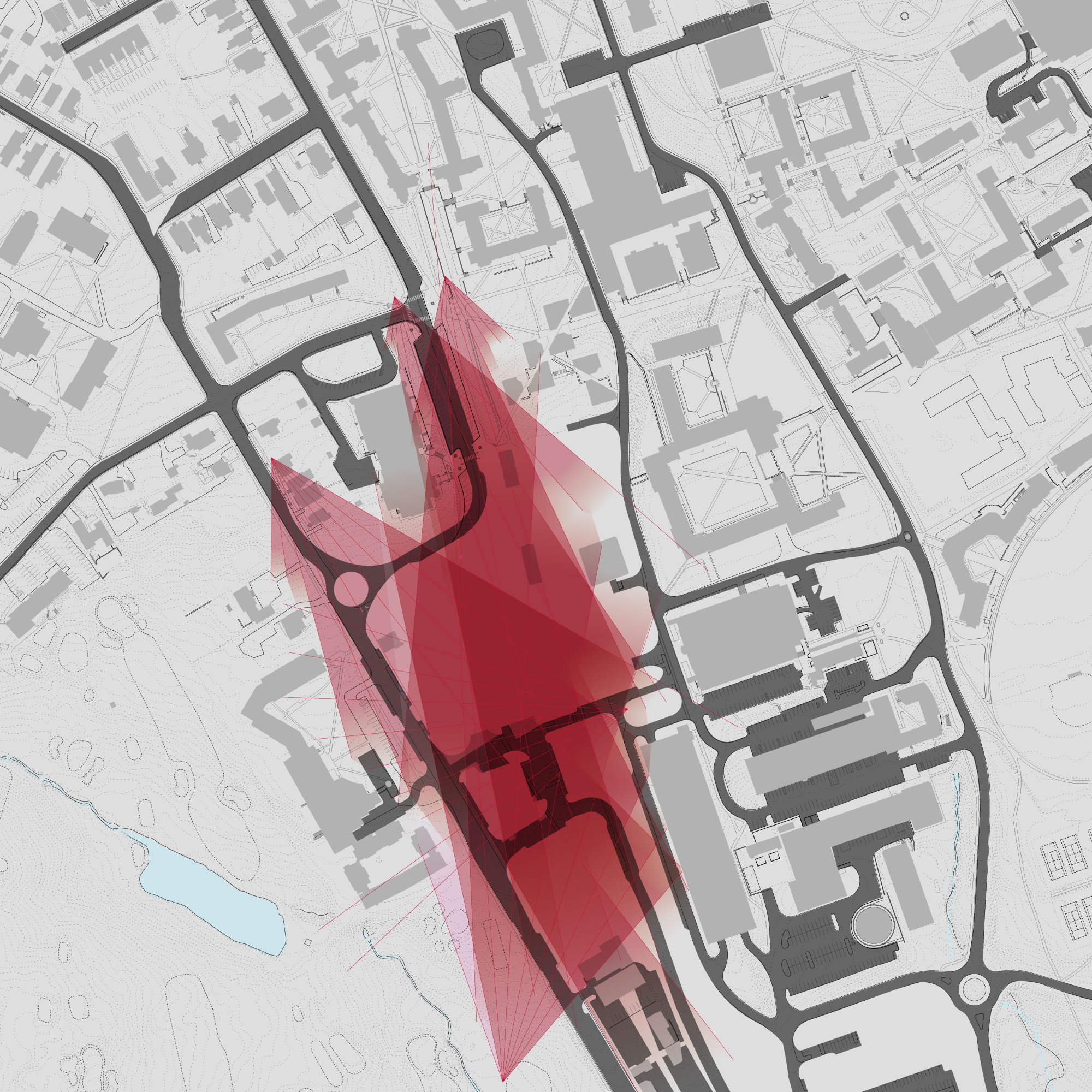
The site is located at the western edge of Princeton’s campus, adjacent to a multi-story parking structure and the light rail terminus known as the “Dinky.” Although it sits within a well-trafficked area, it remains underused and lacks a clear spatial identity.
Introducing a creative arts program at this location reframes the site as both a point of arrival and a destination. The project considers how arts programming can activate this edge condition and connect movement, gathering, and production.
The formal systems developed in earlier studies were brought to the site and tested against existing constraints — circulation patterns, access, and campus flow. Circulation extends the linear systems established in the initial studies, organizing movement across the site and establishing points of entry and intersection.
Rather than imposing a fixed composition, the project adapts its formal language to the conditions of the site, allowing spatial organization to emerge through use and movement.



Click to Enlarge
ITERATION 3
Program Logic
Five primary program types were studied: Theater, Music, Dance, Fine Arts, and Experimental Arts.
Each was analyzed in terms of scale, visibility, public access, sequencing, lighting conditions, and daily cycles of use. This established a distinction between programs that are controlled and episodic, and those that are open and continuous.
These differences were mapped onto the underlying system of lines, frames, and nodes, linking program to spatial organization. Performance spaces require defined thresholds and controlled access, while rehearsal, making, and exhibition spaces benefit from visibility and repeated daily use.
Program becomes a way of structuring gradients of access, exposure, and interaction across the project.


Click to Enlarge
ITERATION 4
Final Design
The project is organized as a series of connected volumes structured by circulation and program.
Circulation operates as primary lines that move through the site and building, structuring how spaces are entered, connected, and experienced. Structural volumes act as frames that anchor the project, while points of overlap form nodes where movement, production, and gathering intersect.
Performance and exhibition spaces establish a clear presence at the edges of the site. Theaters and the concert hall are positioned in more controlled locations, supporting scheduled and episodic use. More open and continuously active programs — galleries, workshops, and lecture spaces — occupy central and highly visible areas.
Rehearsal and workshop spaces are distributed throughout and aligned with primary circulation paths to encourage overlap between disciplines. Larger rehearsal spaces are positioned along these routes, allowing creative activity to remain visible as part of daily campus life.
The result is a porous organization where movement, making, and performance are closely linked, and where the boundaries between production and presentation are intentionally blurred.


Click to Enlarge
Click to Enlarge
Category: Concept, Institutional
Year: 2008
Location: Princeton, New Jersey
Project Team:
Jeeyun Kim & K.T. Anthony Chan
Work produced under the guidance of Marion Weiss of Weiss/Manfredi at University of Pennsylvania School of Design.